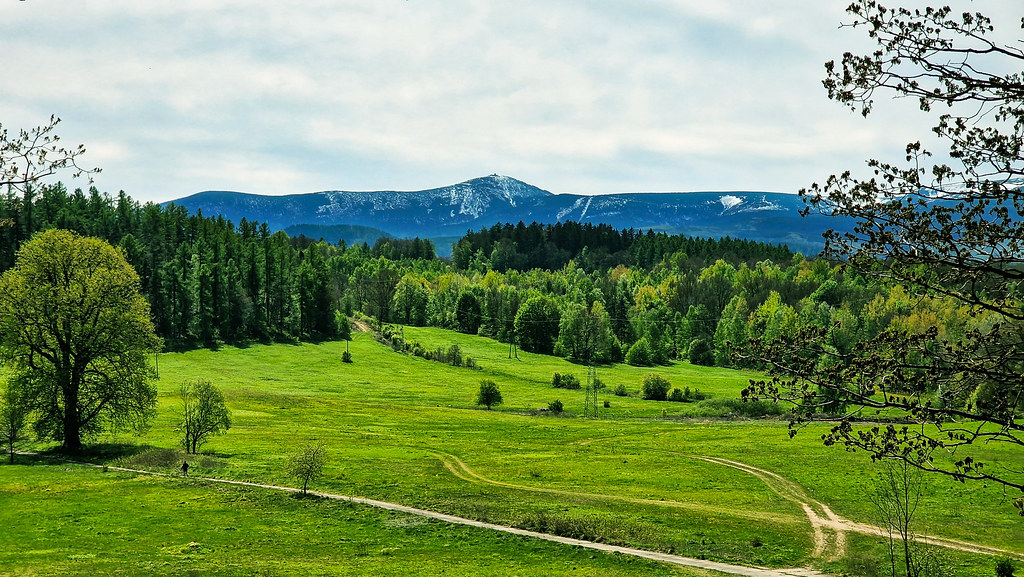
Jelenia Góra ([jɛˈlɛɲa ˈɡura] ; German: Hirschberg; lit. 'deer mountain') is a historic city in southwestern Poland, within the historical region of Lower Silesia. Jelenia Góra is situated in the Lower Silesian Voivodeship, close to the Karkonosze mountain range running along the Polish-Czech border – ski resorts such as Karpacz and Szklarska Poręba are situated 10 to 15 kilometres (6 to 9 miles) from the city. Jelenia Góra constitutes a separate urban gmina as well as being the seat of surrounding Karkonosze County (formerly Jelenia Góra County). In 2021 the population of Jelenia Góra was 77,366. The area, including the oldest spa district of Cieplice Śląskie-Zdrój, is one of the most valued recreational and leisure spots in Poland.The city's history dates back to as early as the 10th century, but the settlement was granted town rights under Polish rule in 1288. Jelenia Góra was founded on important trade routes linking the Holy Roman Empire and Bohemia with Eastern Europe. The region flourished as a result of trade privileges that became the basis for the establishment of weaving and mining industries during the late Middle Ages and early Renaissance periods. Jelenia Góra witnessed many historical conflicts such as the Thirty Years' War and the decisive Silesian Wars. During World War II, the city was miraculously saved from destruction.
The central suburb of Jelenia Góra possesses many historical and architectural structures of great significance, including the 17th-century town hall, baroque churches and a restored central marketplace as well as parks and gardens. The nearby Karkonosze National Park, visited by over 1.5 million tourists annually, has its headquarters in the southwestern neighbourhood of Sobieszów.
Town centre with the Town Hall Square and the main promenade, the Saint Erazm and Pankracy Church http://www.parafia.jelenia-gora.pl/ and the Sanctuary of the Holy Cross http://www.kosciolgarnizonowy.pl/.
Cieplice - a spa district of Jelenia Góra with its park, the Schaffgotsch palace, Spa Theatre, Museum of Natural History http://www.muzeum-cieplice.pl/index.php?lang=en, Church of St John the Baptist and Church of the Saviour.
Various restaurants, cafes, fast food outlets etc. are located in the vicinity of the Town Hall Square and 1 May Street in the city centre. You will also find restaurants and pubs in Cieplice around the Piastowski Square.
To get a bit of the old communistic feeling, head to restaurant Relaks on Ulica 1 Maja near Hotel Europa.
For a bit of old and rusty grandeur, try restaurant Bosman on Ulica Pocztowa opposite the main post office or perhaps the theater restaurant at the intersection Sudecka / Wojska Polskiego.
The most popular fast food in this region is pizza. There is a Pizza Hut on Ulica 1 Maja but better try one of the local pizzerias and don't forget to add the local novelty to it - sos czosnkowy (garlic sauce).
To eat freshly grilled fish in a nice outdoor setting with a beautiful view towards the mountain, go to Cieplice and then further on 1 kilometer towards Karpacz. This fish restaurant is next to a man-made lake with a helicopter randomly placed on one of the islands. This restaurant is surprisingly expensive for being Poland.
There are numerous bars around the town square with flexible closing hours and locals having a Żywiec or a Zubrowka all days of the week. Next to Hotel Baron is the "Irish" pub Belfast, allowing both Protestants and Catholics. Opposite Belfast is the larger and newer Warka. Further up the town square is the posher Metafora. Up pedestrian street Ulica 1 Maja is Play-ta where it is possible to play pool.
Several bars, incl. Belfast and Play-ta, show all the important football games.
The younger clientèle usually end the night at the Atrappa Club, which is in sort of a small park along Ulica Podwale just above the bus stop. It is open until at least 3.00. Opposite the same bus stop is a 24h night shop.
There is also a club/bar for the slightly older crowd on a side street from Ulica 1 Maja in between Ulica Pocztowa and the church. This place is called The Street.
Try some hot spring water from Cieplice spa. The spa's history dates back to XIII century and since then it has been used for various ailments. Among the notable visitors were Polish Queen Marysieńka, Johann Wolfgang von Goethe and American president John Quincy Adams.
There are various shops located in the centre of Jelenia Góra and its suburb, Cieplice.
Two major shopping centres are Tesco and Echo. To get to the Tesco shopping centre you can just take a walk from the town centre. There is also a bus 'TES' running from Zabobrze to the shopping centre. To get to the Echo shopping centre take a bus no. 6, 7 or 27.
You will often find the locals displaying signs usually in Polish and German ("pokoje/Zimmer") to advertise rooms available for short-term stays. However, note that you will mostly see them along the main roads and not in the city centre or residential areas.
There are also many hotels, especially in Cieplice as its hot spring water is popular with visitors.
No information available